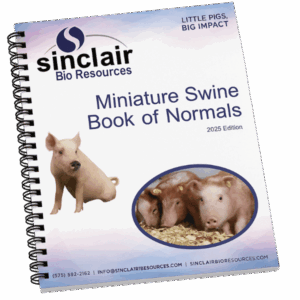
Hello, my name is Rhiannon Hardwick. I’m a Director in Discovery Toxicology at Bristol-Myers Squibb and I’d like to share with you our onboarding efforts for nano pigs as an additional non rodent species within the organization.
Now, as many may be aware, we have been facing as an industry not non-human primate shortages and use considerations, which is a challenge across all pharmaceutical companies. We have seen a global shortage of primates as well as increased cultural and ethical sensitivity to the use of both primates and dogs.
And this is arising from both sourcing challenges and importing challenges, as well as the impact of the COVID-19 pandemic. So we are seeing now that the selection of primates as a non-clinical species requires even stronger science-based justification for health authorities than ever before.
And what this means is that it is not sufficient to provide evidence that a species is pharmacologically relevant. We must also demonstrate that other species are not pharmacologically relevant, and this is becoming ever more imperative.
So our solution to this challenge was to onboard nanopigs as an additional non-clinical species to support the BMS R&D pipeline and this was to utilize nanopigs across the pipeline initiating and discovery through regulatory activities.
To serve all modalities, including small molecules such as agonists and antagonists, as well as targeted protein degraders and various biologics such as antibody drug conjugates and more.
Our vision was to enable the use of Nano Pig as an additional non-clinical species to support the BMS R&D pipeline. So to do this, we launched A cross-functional working group with three functional leads representing our veterinary sciences group.
Our Pharmaceutical Candidate Optimization group, which includes Discovery Toxicology, Discovery DMPK, Discovery Pharmaceutics and Development DMPK, as well as our Non-clinical Safety team, which includes our regulatory toxicology body.
Our operating model was such that the leads were to develop subteams within their functions and craft function specific onboarding strategies as our needs throughout the pipeline were slightly different.
The leads were then to facilitate coordination and collaboration across the entirety of the organization.
Our mission initially was to gather existing knowledge, identify any knowledge gaps, and determine what activities and studies were needed to support the use of nanopigs in both PK as well as toxicology in vivo studies.
What this meant was for our veterinary sciences team to develop training protocols to enable handling skills for all in vivo staff, implement husbandry protocols and ensure adequate facilities for housing.
Within our discovery group PCO, the goal was to generate assays and data sets to inform the relevance of Nanopig and facilitate the selection of Nanopig by program representatives where appropriate as their non rodent species.
And within our regulatory or NCS group, they were to implement a strategy for conducting GLP toxicology studies and all necessary supporting analysis, as well as being aware of background and historical control data in nanopigs and building internal databases.
Where appropriate.
So as we moved through this process, we developed several key considerations to enable the implementation, and this sought to address needs from early discovery throughout development into the regulatory space. This first began with knowledge gathering and sharing.
We needed to understand what info is publicly available on nanopigs and what data needed to be generated internally. We had to identify what relevant info is needed to support the selection of nanopigs on programs.
In order to initiate in vivo studies, so
me of the things to consider include metabolizing enzyme and transporter expression, excipient tolerability.
Clinical pathology reference ranges so that we could understand what was the normal range, as well as any inherent background athologies within the Nanig.
And then we had to move to enabling the implementation. So we needed to know what activities did we envision throughout the pipeline. We had to identify what core capabilities needed to be put in place to conduct studies in pigs.
And some of the things to consider included dosing methodologies, genomics and proteomics protocols.Ability for epitope mapping and target binding assessments, as well as clinical pathology and flow cytometry capabilities. This has been a very fruitful process with many learnings along the way.And I would like to close by acknowledging it is a cross-functional effort that requires the expertise as well as hands-on activities of multiple individuals across multiple functions. And with that, I will thank you for your time.